
Products
Knit tops
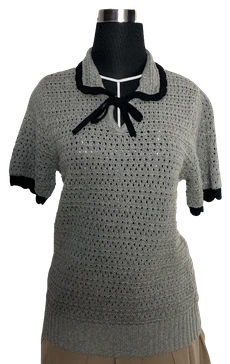
Produksee manufactures knit tops in Indonesia, including pointelle and open-stitch constructions, short-sleeve silhouettes and contrast-trimmed necklines. Open-structure knitting requires stable yarn selection and controlled blocking, which Produksee handles in-house for export and domestic fashion brands.
The problem
Pointelle and open-stitch fabrics are the hardest thing in a knitwear range to keep consistent. The holes are deliberate, which means every irregularity reads as a fault rather than as texture — and blocking, not knitting, is where they are won or lost.
Construction
What we control on an open-structure top
Hole regularity
In a pointelle the eye reads the grid, not the stitch. Tension is monitored across the panel width so the pattern does not drift toward the selvedge.
Blocking discipline
An open structure will take whatever shape it is dried in. Panels are blocked to measurement, not pressed flat and hoped for.
Yarn stability
A soft, loosely twisted yarn feels beautiful and will not hold an open structure. We flag that trade-off before sampling, not after.
Contrast trims
The dark collar and tie on this sample sit against an open ground, so any yarn migration between colours is visible. Colours are knitted, not dyed together.
Specification
Production specification
Send a tech pack and we quote against it directly. The figures below are being confirmed with our production floor.
We quote gauge, minimum order per style and per colour, yarn options, sampling turnaround and production lead time against your specific style — not from a rate card. Send a tech pack and you get all six back, costed, on WhatsApp.
- Gauge range
- Minimum order, per style
- Minimum order, per colour
- Yarn compositions
- Sampling turnaround
- Production lead time
FAQ
Frequently asked
Can you develop a custom pointelle pattern?
Yes. Send artwork or a physical reference and we translate it into a stitch structure at your gauge, then knit a swatch before committing to a sample.
Do open-stitch garments need special care labelling?
Usually yes. We advise on care instructions based on the actual yarn and structure rather than a generic knitwear label.
Are minimums higher for open-structure knits?
They can be, because development takes longer. Confirm your specific structure with us — the figures on this page are being finalised.
Frequently asked
Related categories
Knit cardigans
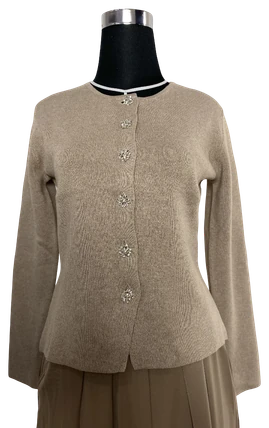
A cardigan is judged at the button band. It carries the wearer's eye, it takes the most handling, and it is the first place a badly balanced knit shows itself — the band ripples, the fronts hang unevenly, and the garment looks cheap before anyone has read the label.
Sweaters & pullovers
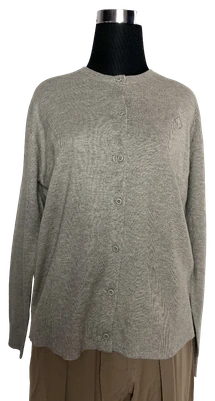
An oversized sweater is not a fitted sweater cut larger. The drop shoulder moves the balance point off the shoulder seam, so the whole garment hangs from the neckline instead — and if the neck rib is knitted at the wrong tension, the body pulls the collar out of shape within a season.
Knit vests
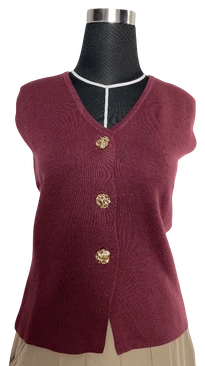
A vest is mostly edge. Take the sleeves off a knitted garment and the armhole, the neckline and the front band become almost the whole thing — which is why a vest exposes bad finishing faster than any other knit in a range.
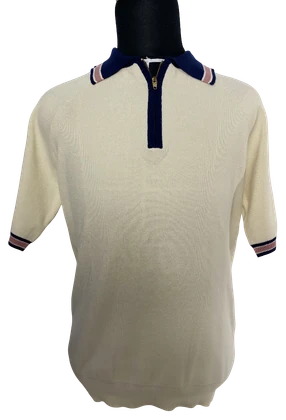
Knit polos
A knit polo is where the factory's collar work is on public display. Tipping, striping, and placket alignment all have to land within a millimetre of each other on a piece the wearer sees in the mirror every time they put it on.
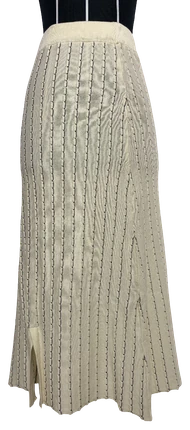
Knit skirts
A knitted skirt has one job that a knitted top never has: it must not grow. Gravity works on a vertical panel all day, and a rib that recovers beautifully at the cuff of a sweater will let a skirt drop two centimetres by the afternoon.
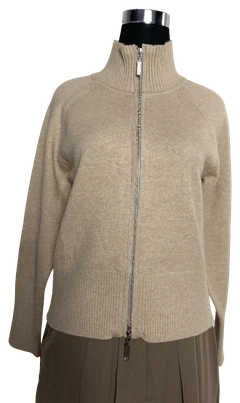
Zip-up knit jackets
Putting a zip into a knitted garment is a structural problem, not a trim problem. A zip is rigid and the fabric around it is not, so unless the band is stabilised properly the front waves — and a waving zip is the single most common reason a knitted jacket gets rejected at inspection.
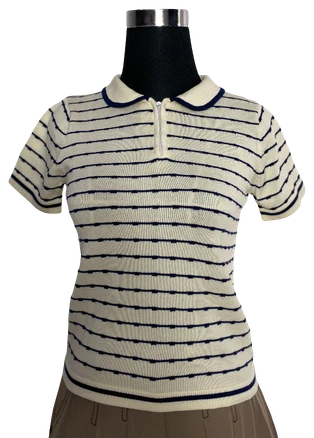
Custom & jacquard knitwear
In a jacquard, the pattern is not printed onto the garment — it is the garment. The colour changes are structural, which is why a jacquard cannot be corrected after knitting and why the swatch stage is where the money is actually spent.
Tell us what you are producing.
Send the style, the quantity and the delivery window — attach the tech pack on WhatsApp and we come back with a costed quote, not a brochure.